
Standard 4.5
Standard 4.5
4.5 Use ICT safely, responsibly and ethically
‘Demonstrate an understanding of the relevant issues and the strategies available to support the safe, responsible and ethical use of ICT in learning and teaching.’
During my practicum in a Year 5 classroom, I encouraged students to act responsibly when using ICT, particularly online, through a lesson where we examined ethical behaviour online and the impacts of cyberbullying. I planned this lesson in response to current events happening in the classroom; some students had been coming to school upset about things that were said online the night before. I consulted with the other teachers about what the issues were and we decided that the students needed to think carefully about their behaviour online.
I did extensive research before planning the lesson to ensure that the students would see the relevance. I looked at a range of cyberbullying/online behaviour resources to have a solid understanding of what types of different approaches existed, and there are many useful guidelines already in existence (Catholic Education Diocese of Parramatta, 2016). My mentor teacher referred me to the Office of the Children’s E-safety commissioner, and I did extensive reading of their resources for teachers and suggested lesson plans (Office of the Children's E-safety Commissioner, 2016). I decided to take inspiration from a few resources and do a few activities with the class that allowed students to explore the issue. All of these activities were done with the underlying idea that ‘being safe and supported at school is essential for student wellbeing and effective learning’ (Safe Schools, 2014).
I started the session with a ‘whole class thermometer’- I asked a question or suggested a statement and the students would move across the classroom to demonstrate how much they agreed or disagreed. One statement was ‘what you say online doesn’t matter as much as what you say in person’. Students arranged themselves along the line, and we discussed what this meant and if this was true or not. Students had rich suggestions and I was careful to prevent anyone from sharing things that might be too revealing. I encouraged a safe and supportive environment by allowing all children to have a chance to be heard and listened to by their classmates.
The students then heard a case study about an incident involving three fictional children, where things were said and photos were shared online. Students responded to this situation in groups by working together to answer questions on a large piece of butcher’s paper (see photo). We then discussed why each group wrote what they did and if their classmates agreed or disagreed with them. This inspired a rich discussion about seeking permission from friends before posting their pictures or information only.
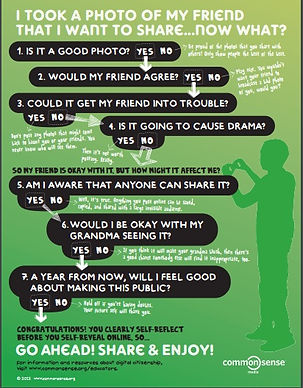
After the session, posters were placed around the class to reinforce what was discussed. This included a ‘Should I post it?’ flowchart (Common Sense Media, 2016). We talked through it as a class and students discussed why it is important to think of the bigger picture when interacting online. This is a tool students continue to refer to to help them navigate respectfully online.
References
AITSL,. (2014). Australian Institute for Teaching and School Leadership. Aitsl.edu.au. Retrieved 20 October 2016, from http://www.aitsl.edu.au/australian-professional-standards-for-teachers/illustrations-of-practice/detail?id=IOP00020
Australian Government DET,. (2014). Safe Schools Toolkit. Safeschoolshub.edu.au. Retrieved 7 September 2016, from http://safeschoolshub.edu.au/safe-schools-toolkit/overview
Catholic Education Diocese of Parramatta,. (2016). Responsible Use of ICT and Social Media for Students. Parramatta.
Keeping Safe Online - Education Directorate. (2016). Education.act.gov.au. Retrieved 7 September 2016, from http://www.education.act.gov.au/teaching_and_learning/learn-anywhere-ict-for-students/keeping-safe-online
Office of the Children's E-safety Commissioner. (2016). Esafety.gov.au. Retrieved 7 September 2016, from https://esafety.gov.au/
Online safety poster. (2016). Common Sense Media. Retrieved 7 September 2016, from http://www.yrdsb.ca/schools/windhamridge.ps/students/Documents/DigitalPOSTER2.pdf
Online safety poster from Common Sense Media
Case study questions. Photo by M Geller

This 'Illustration of Practice' from the AITSL website explores how teacher confidence effects student safety when using ICT. Students are reminded to act responsible and are congratulated for acting responsibly online.
Property of AITSL.