Standard 2.6
Standard 2: Know the content and how to teach it
2.6 Information and Communication Technology (ICT): Implement teaching strategies for using ICT to expand curriculum learning opportunities for students.
ICT is widely accepted to be a means of creating a good learning environment, with computers expected to assist students in acquiring new knowledge and independence (Jedeskog & Nissen, 2004). However, it is important that ICT be used only when it will contribute to the learning experience, rather than ‘just because’. Sutherland et al (2004) argue that the same teaching and learning pedagogies should be applied to learning with ICTs, and educators should not ignore ‘general theoretical perspectives’ in favour of ‘new’ pedagogies surrounding ICT. They suggest that teachers and policy makers should engage with ICT tools with caution, using them to enhance learning but being wary to avoid replacing ‘older technologies’ such as pen and paper, as students need to be skilled in working with both (Sutherland et al, 2004). Bingimlas (2008) notes that while there is a strong desire from teachers to integrate ICT into their classroom activities, barriers such as ‘lack of confidence, lack of competence and lack of access to resources’ often stood in their way. As such, it is important for aspiring teachers such as myself to engage with different forms ICT in order to develop my own skills for using it in the classroom.
There are many ways I use ICT in my teaching to create a richer learning environment for students. I use it to stimulate interest, deliver rich audio-visual and interactive content, and review concepts.
In one lesson I used a comic strip to help stimulate student interest and discussion about quotation marks. The comic strip was sourced from the internet and projected on the smartboard for the students to read and view. They then had to rewrite the dialogue using correct punctuation in their writing books. The students enjoyed this activity; they were entertained by the use of familiar characters and a new text format (comic strip), and they were able to work at their own pace, referring back to the comic strip on the board.
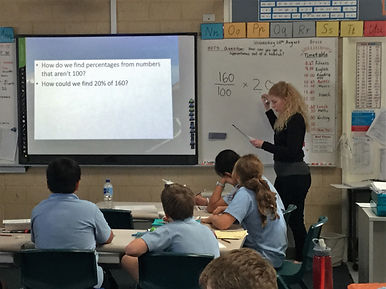
In another lesson, the smartboard was used to help the students explore the concept of percentages at their own pace. The problem was projected on the board for all to see, and I then worked through it with them using the ‘I do, we do, you do’ model. The ease of simply flipping forward to the next slide for a fresh problem makes it easy to keep pace with the students working.
One of my favourite ways to use ICT in the classroom is for reviewing concepts, particularly before a test. I have seen students of all ages alert and interested in a smartboard quiz! In a year 3 geometry unit, the smartboard was used to allow students to draw and interact with the grid on the board. Students were attentive and actively listening in the hopes that they might be chosen to come up and work on the board. Having an interactive activity on the smartboard allows for teacher and student modelling and demonstration of a skill to the class.
By using ICT as a learning tool to stimulate interest, engage students with the content and review before assessment, I aim to broaden learning opportunities for all students in the classroom.
For another example of my use of ICT, visit my Reflective Journal which details an activity I designed and implemented using an E-book.
References
Bingimlas, K. (2008). Barriers to the Successful Integration of ICT in Teaching and Learning Environments: A Review of the Literature. Eurasia Journal Of Mathematics, Science And Technology Education, 5(3), 235-245.
Jedeskog, G. & Nissen, J. (2004). ICT in the Classroom: Is Doing More Important than Knowing?.Education And Information Technologies, 9(1), 37-45. http://dx.doi.org/10.1023/b:eait.0000024260.17501.e6
Sutherland, R., Armstrong, V., Barnes, S., Brawn, R., Breeze, N., & Gall, M. et al. (2004). Transforming teaching and learning: embedding ICT into everyday classroom practices. Journal Of Computer Assisted Learning, 20(6), 413-425. http://dx.doi.org/10.1111/j.1365-2729.2004.00104.x
Tondeur, J., van Keer, H., van Braak, J., & Valcke, M. (2008). ICT integration in the classroom: Challenging the potential of a school policy. Computers & Education, 51(1), 212-223. http://dx.doi.org/10.1016/j.compedu.2007.05.003
'I do, we do, you do' using the smartboard. Photo by J Nguyen.
Reviewing concepts using ICT. Photo by M Geller.
ICT can be used to stimulate interest and display content for the students. Photo by J Nguyen.